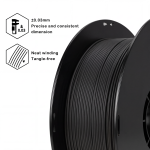
PA6 Carbon Fiber Filament – Product Overview
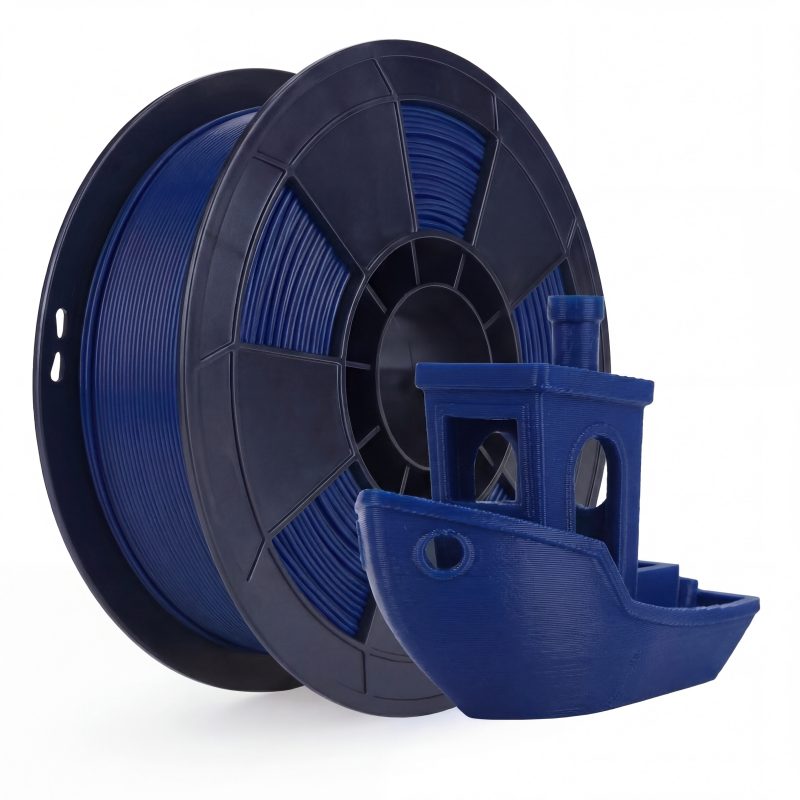
The SigmaFilament PA6 Carbon Fiber Filament is where 3D printing meets genuine industrial manufacturing capability. This isn’t a material for decorative prints or hobby projects – it’s an engineering-grade composite designed to produce parts that replace machined metal and injection-molded components in demanding real-world applications.
PA6 (Nylon 6) is one of the most widely used engineering polymers in industrial manufacturing – valued for its exceptional toughness, fatigue resistance, chemical stability, and ability to perform under sustained mechanical stress. By reinforcing this proven polymer matrix with chopped carbon fiber, SigmaFilament’s PA6-CF delivers dramatically enhanced stiffness, dimensional stability, heat resistance, and wear performance – creating a printable material that approaches the mechanical envelope of traditional manufacturing.
The numbers tell the story: tensile strength exceeding 80 MPa, heat deflection above 180°C, flexural modulus approaching 7,000 MPa, and wear resistance that allows direct use in bearing surfaces, gear trains, and sliding assemblies. These aren’t aspirational specifications – they’re the performance level required by automotive engineers, aerospace prototypers, and industrial equipment designers who are evaluating 3D printing as a viable production method.
A critical advancement in this formulation is reduced moisture absorption. Standard nylon filaments are notoriously hygroscopic, absorbing atmospheric moisture that causes print quality issues and dimensional instability. SigmaFilament’s PA6-CF uses an optimized formulation and carbon fiber content that significantly reduces water uptake compared to unfilled PA6, making it more practical for real-world production environments.
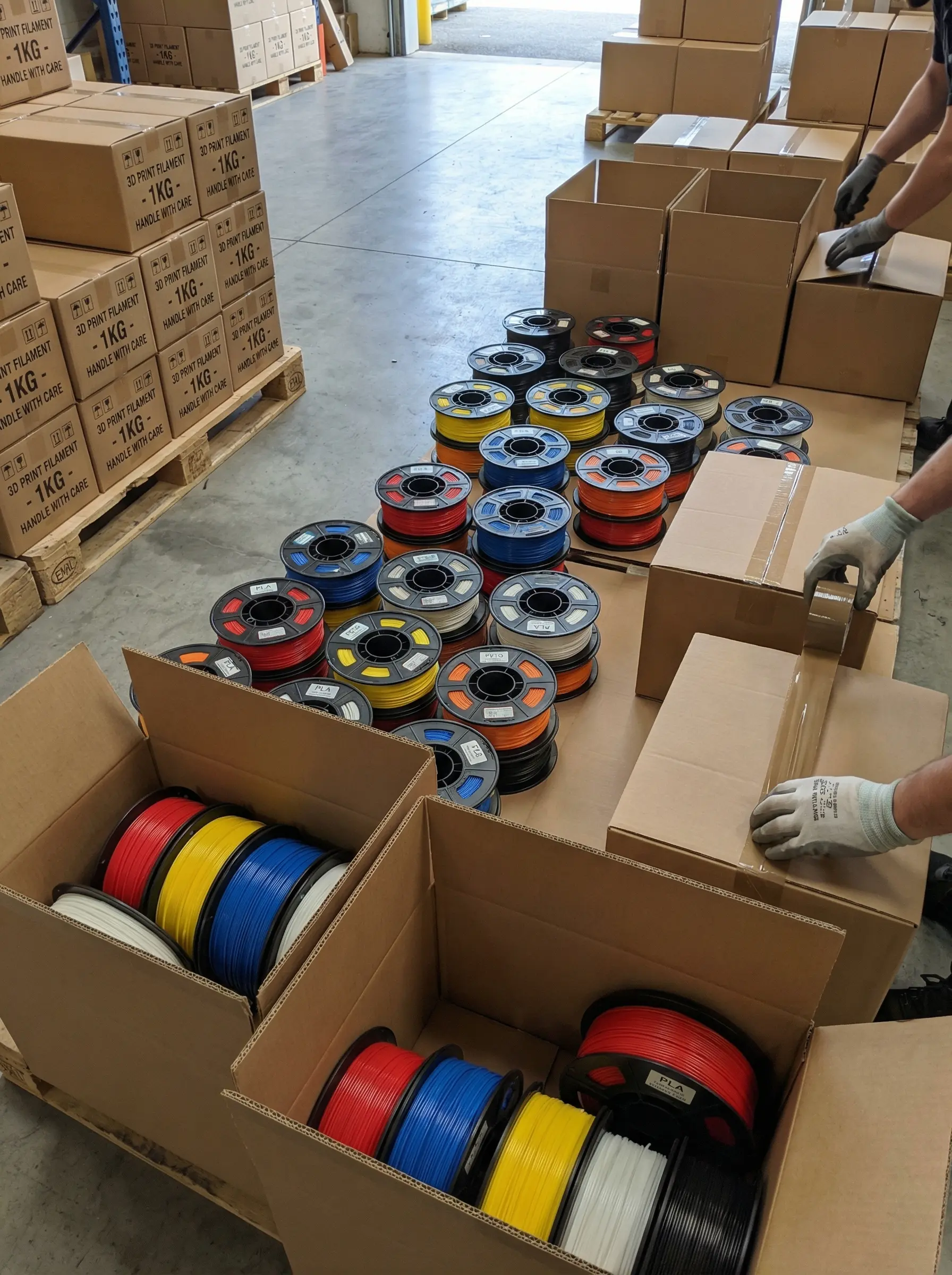
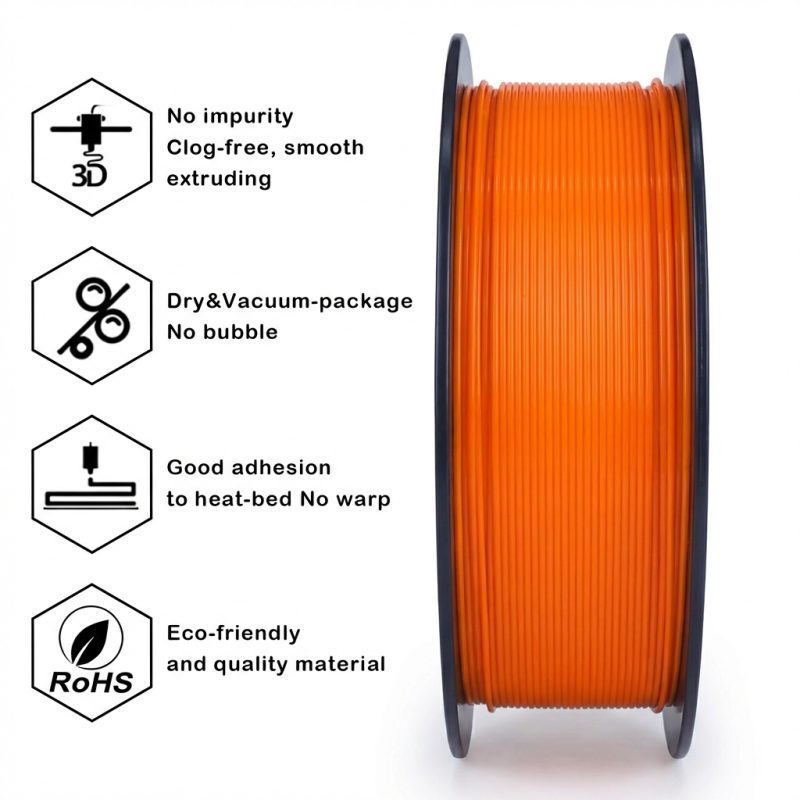
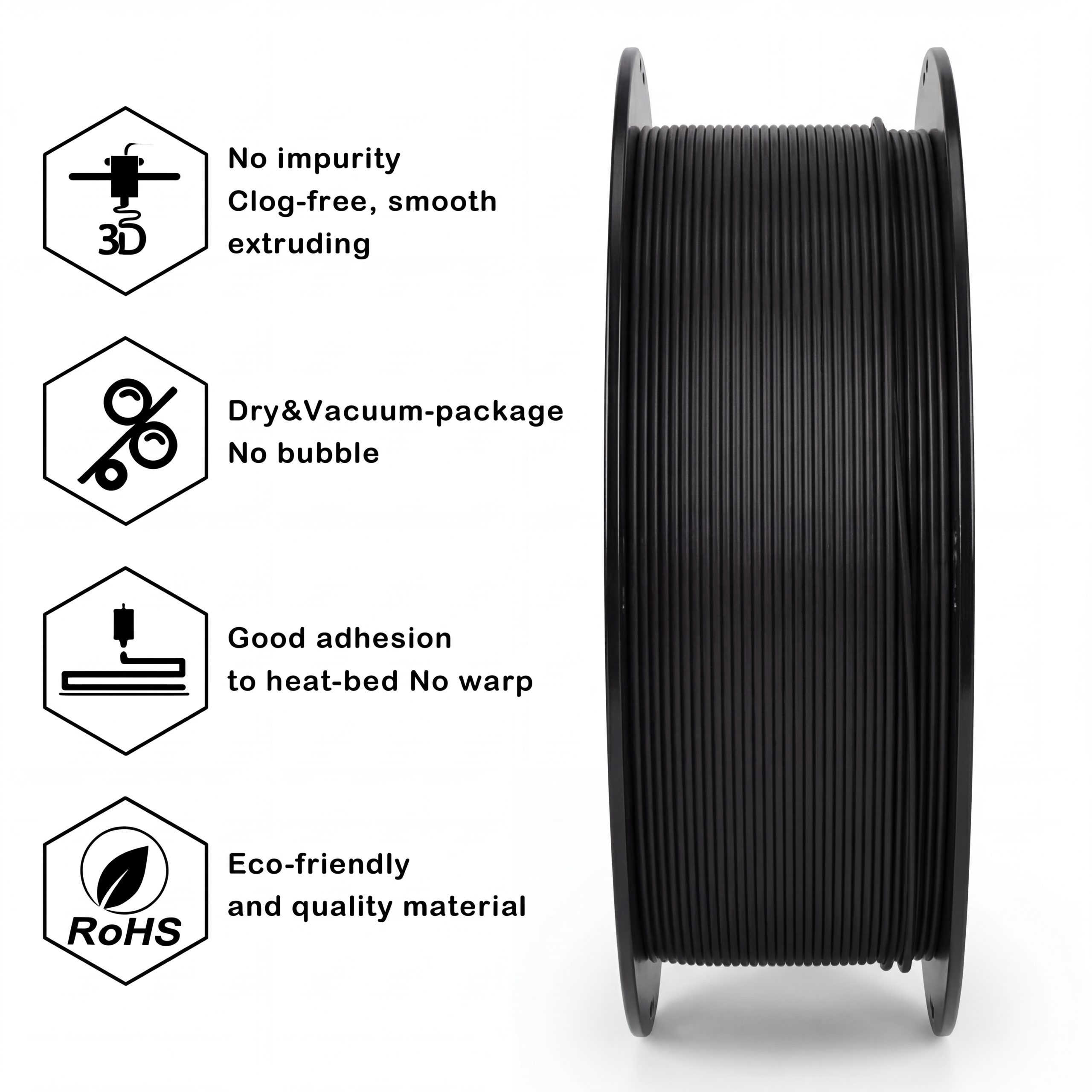
Manufactured under ISO 9001 quality management in Guangdong, China. Full RoHS compliance, OEM/ODM services, and free samples available.
Why This PA6 Carbon Fiber Filament Stands Out
⚙️ Industrial Performance – The Material That Replaces Metal
When PLA cracks, PETG flexes, and ABS warps – PA6 Carbon Fiber delivers. This is the material for engineers who need parts that actually work under real-world industrial conditions.
- Metal-Replacement Strength – Tensile strength >80 MPa combined with carbon fiber stiffness produces parts that can structurally replace aluminum in many applications at 1/3 the weight. The strength-to-weight ratio makes PA6-CF the go-to material for lightweighting initiatives in automotive, aerospace, and robotics
- 180°C+ Heat Resistance – While PLA fails at 55°C and PETG at 80°C, PA6-CF maintains structural integrity above 180°C. This enables use in engine compartments, near electric motors, in industrial ovens, alongside hot manufacturing processes, and in any environment where thermal exposure is a design constraint
- Exceptional Wear Resistance – The carbon fiber reinforcement creates a self-lubricating surface with dramatically improved abrasion resistance. PA6-CF parts can serve as bearing surfaces, bushings, guide rails, cam followers, and gear teeth – applications where PLA/PETG would wear through in hours
- Chemical Fortress – Resists oils, greases, fuels (gasoline, diesel), hydraulic fluids, most solvents, and dilute acids/bases. Parts survive in automotive, marine, agricultural, and industrial chemical environments without degradation
- Low Moisture Optimized – Standard nylon absorbs 2-8% atmospheric moisture, causing dimensional changes and print quality issues. This PA6-CF formulation reduces absorption significantly through optimized polymer-fiber interface and carbon fiber content, making it more predictable and practical for production use
- Fatigue Champion – PA6’s inherent fatigue resistance (the best among common 3D printing polymers) combined with CF stiffness means parts withstand millions of loading cycles without failure – critical for moving mechanical assemblies, snap fits, and living hinges
The filament that makes manufacturing engineers say “we can print that instead of machining it” – and mean it.
Why Choose PA6 Carbon Fiber
| 🏭 Production Parts | PA6-CF is not a prototyping material – it’s a production material. Parts printed in this filament can serve as end-use components in industrial equipment, automotive assemblies, and consumer products. The mechanical properties meet or exceed the requirements for many applications traditionally served by injection-molded PA6-GF (glass-filled nylon) – but with the design freedom and rapid iteration speed of 3D printing. |
| 🚗 Automotive | Under-hood components, air intake ducting, sensor brackets, cable routing clips, custom jigs for assembly lines, and interior structural elements. PA6-CF survives the automotive thermal and chemical environment (engine heat, oil splash, fuel vapor, vibration) that destroys commodity filaments. Automotive OEMs and Tier 1 suppliers increasingly specify PA6-CF for low-to-medium volume production parts. |
| ✈️ Aerospace Prototyping | Structural prototypes, interior component development, tooling aids, and form/fit/function test parts. The strength-to-weight ratio of PA6-CF makes it the closest 3D printable approximation to the engineering plastics used in aerospace production (PEEK, PEI, PA12-CF). It enables meaningful mechanical testing at a fraction of the cost and lead time of machined prototypes. |
| ⚙️ Tooling & Fixtures | Production jigs, assembly fixtures, quality inspection gauges, robot end-effectors, and workholding tools. PA6-CF tooling outlasts PLA/PETG tooling by 10-50x in terms of wear cycles, and its dimensional stability under heat and chemical exposure means tools maintain calibration accuracy throughout their service life. |
| 🔧 Mechanical Components | Gears, bearings, bushings, cam followers, guide rails, pulleys, and structural brackets. PA6-CF’s combination of stiffness, wear resistance, and fatigue life makes it suitable for moving mechanical assemblies – the application category where commodity filaments fail fastest. The CF-enhanced self-lubricating surface reduces friction and extends component service life. |
| 🏗️ Structural Applications | Load-bearing brackets, structural supports, equipment mounting plates, and reinforcement components. PA6-CF’s combination of high tensile strength (>80 MPa), excellent interlayer adhesion (nylon bonds exceptionally well between layers), and carbon fiber stiffness produces structurally reliable parts for sustained load applications. |
PA6 Carbon Fiber vs. PETG vs. PLA Carbon Fiber vs. ABS – Engineering Material Comparison
| Property | PA6 CF (This) | PETG | PLA CF | ABS |
|---|---|---|---|---|
| Tensile Strength | >80 MPa ★★★★★ | 45-53 MPa | 45-55 MPa | 40-50 MPa |
| Heat Resistance (HDT) | 180°C+ ★★★★★ | ~80°C | ~55°C | ~100°C |
| Wear Resistance | ★★★★★ (Self-lubricating) | ★★★☆☆ | ★★★☆☆ | ★★★☆☆ |
| Chemical Resistance | ★★★★★ (Oils, fuels, solvents) | ★★★★☆ | ★★☆☆☆ | ★★★☆☆ |
| Fatigue Resistance | ★★★★★ (Millions of cycles) | ★★★★☆ | ★★☆☆☆ (Brittle) | ★★★☆☆ |
| Print Difficulty | Advanced (enclosure + drying) | Moderate | Easy | Moderate |
| Best For | Industrial/automotive/aerospace | General engineering | Stiff decorative parts | Enclosure-based parts |
Print Settings – Advanced Material
⚠️ IMPORTANT – PA6-CF is an Advanced Engineering Material:
This filament requires specific hardware and preparation. Read all requirements before purchasing.
1. Enclosed printer strongly recommended – Chamber temperature 50-60°C reduces warping and improves interlayer adhesion. Open-frame printers can work for small parts but will struggle with larger geometries.
2. Hardened steel nozzle REQUIRED – Carbon fiber rapidly destroys brass nozzles. Hardened steel, ruby, or tungsten carbide nozzle mandatory. 0.4mm minimum, 0.6mm recommended for best CF flow.
3. Thorough drying is MANDATORY – PA6 is hygroscopic. Dry at 80°C for 8-12 hours before printing. Use a dry box during printing for sessions over 2 hours. Wet PA6-CF produces catastrophically poor results.
4. All-metal hotend required – 260-300°C exceeds PTFE limits. Ensure your hotend is rated for these temperatures.
Optimal Settings
| Nozzle Temperature | 260-300°C (280°C optimal for most printers) |
| Bed Temperature | 80-100°C (90°C recommended; PEI or Garolite bed surface) |
| Print Speed | 30-50mm/s (slower = stronger interlayer bonding) |
| Layer Height | 0.15-0.25mm (0.20mm balanced strength/speed) |
| Cooling Fan | 0-20% (minimal cooling; nylon needs heat retention for bonding) |
| Wall Count | 4+ walls for structural parts (CF strength is in the walls) |
| Retraction | 1-3mm / 25-40mm/s (direct drive); 3-5mm (Bowden) – gentle settings |
| Infill | 30-50% for structural; 60%+ for maximum load-bearing |
| Enclosure | Strongly recommended (50-60°C chamber temp) |
| Nozzle | Hardened steel REQUIRED (0.4mm min, 0.6mm recommended) |
| Bed Surface | PEI (textured preferred), Garolite G10, or glass with nylon-specific adhesive |
| Drying | 80°C for 8-12 hours (MANDATORY before every print session) |
Technical Specifications
| Parameter | Specification |
|---|---|
| Material | PA6 (Nylon 6) + Chopped Carbon Fiber |
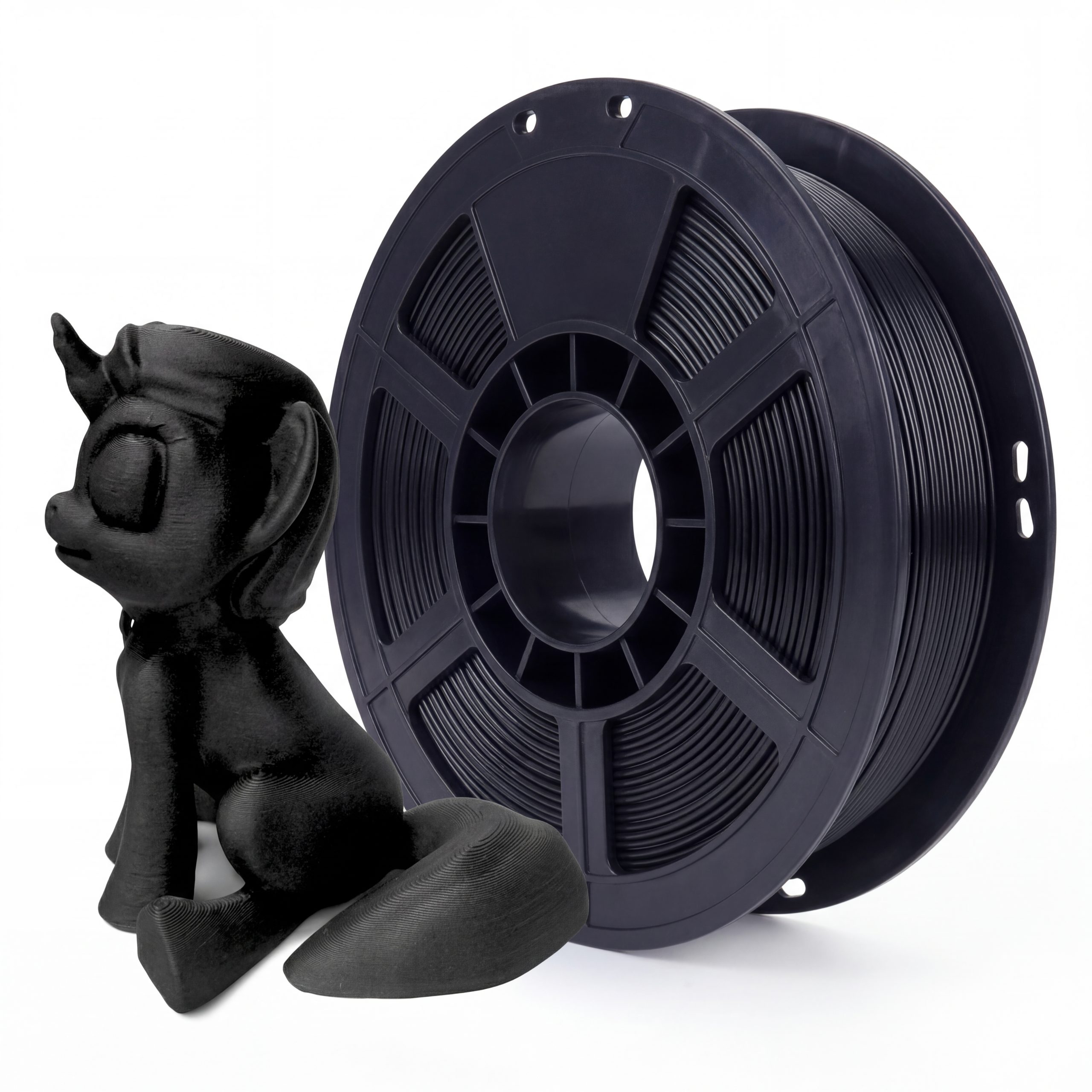
| Color | Black (Matte CF Finish) |
| Model | PA6-CF |
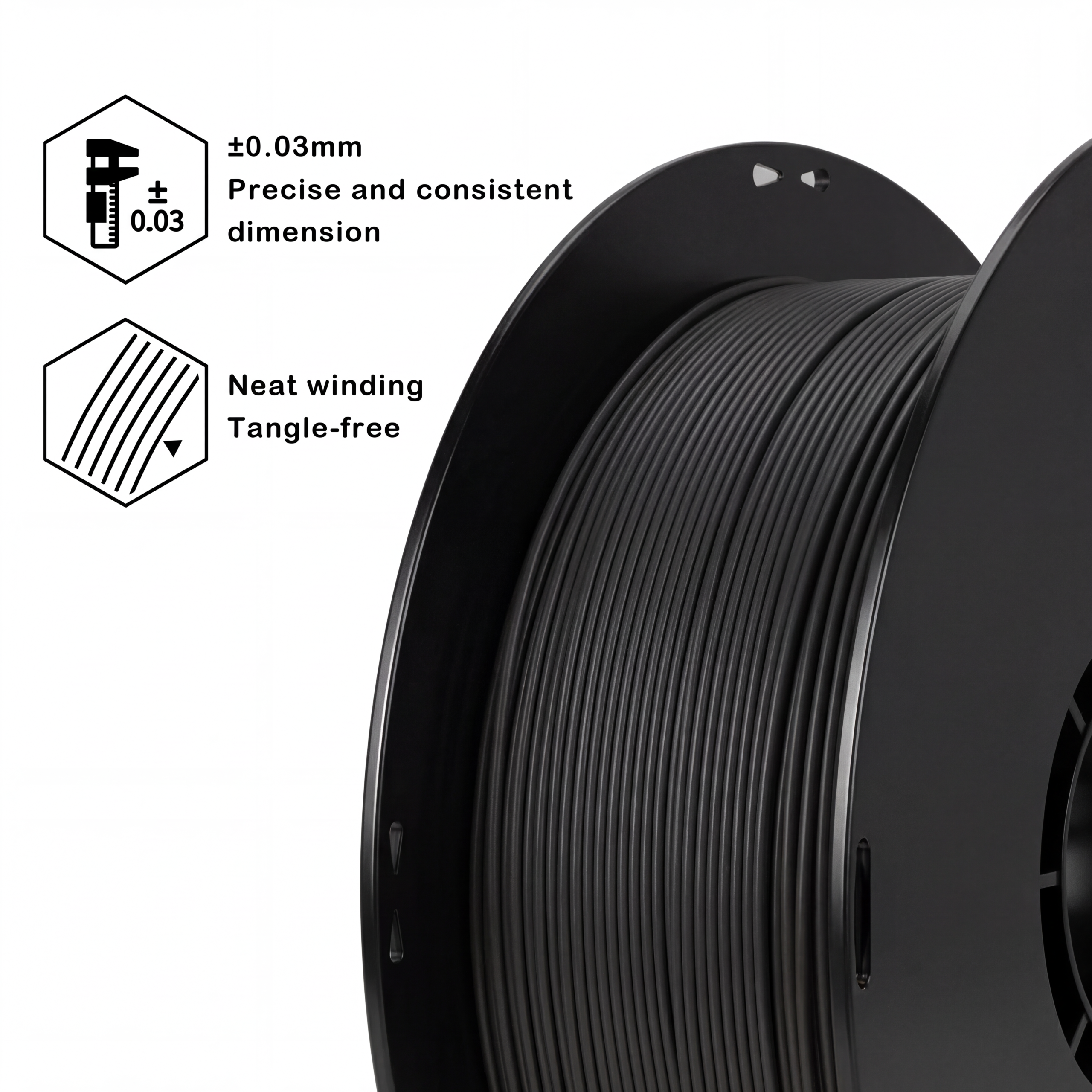
| Diameter | 1.75mm ± 0.05mm |
| Net Weight | 1kg (2.2 lbs) |
| Nozzle Temp | 260-300°C |
| Bed Temp | 80-100°C |
| Speed | 30-50mm/s |
| Enclosure | Strongly recommended (50-60°C chamber) |
| Nozzle Type | Hardened steel / ruby / tungsten carbide REQUIRED |
| Drying | 80°C for 8-12 hours (mandatory) |
| Packaging | Vacuum sealed with desiccant |
| Origin | Guangdong, China |
| Free Sample | Available |
| OEM/ODM | Available – Learn more |
Material Properties & Performance
| Property | Value | Standard |
|---|---|---|
| Tensile Strength | >80 MPa | ISO 527 / ASTM D638 |
| Flexural Modulus | 6,000-8,000 MPa | ISO 178 / ASTM D790 |
| Impact Strength (Izod, Notched) | 5-8 kJ/m² | ISO 180 / ASTM D256 |
| Elongation at Break | 3-6% | ISO 527 / ASTM D638 |
| Heat Deflection Temperature | >180°C (0.45 MPa) | ISO 75 / ASTM D648 |
| Continuous Use Temperature | Up to 150°C sustained | – |
| Density | 1.15-1.20 g/cm³ | ISO 1183 |
| Moisture Absorption (24h) | Reduced vs. standard PA6 (optimized formulation) | ISO 62 |
| Friction Coefficient | Low (CF self-lubricating effect) | – |
| Shrinkage | 0.4-0.8% (enclosure recommended) | ISO 294-4 |
Applications
| 🚗 Automotive | Under-hood brackets, intake manifold prototypes, sensor housings, cable clips, custom assembly tooling, and interior structural components. Survives engine heat, oil, and vibration. Used by OEMs and Tier 1 suppliers for low-volume production and bridge manufacturing. |
| ✈️ Aerospace | Structural prototypes, interior component development, tooling aids, and UAV/drone structural elements. Best strength-to-weight ratio available in desktop FDM. Enables meaningful mechanical testing before committing to PEEK/Ultem production. |
| ⚙️ Industrial Machinery | Gears, bearings, bushings, guide rails, cam followers, pulleys, and wear plates. Self-lubricating CF surface extends component life. Chemical resistance handles industrial fluids. Fatigue resistance for millions of loading cycles. |
| 🔧 Production Tooling | Assembly jigs, inspection gauges, workholding fixtures, robot end-effectors, and quality check tools. 10-50x longer service life than PLA/PETG tooling. Dimensional stability under heat and chemical exposure. |
| 🤖 Robotics | Robot structural components, gripper fingers, sensor mounts, cable management, and custom end-effectors. Lightweight (1.15-1.20 g/cm³) with high stiffness for precision robotic applications. |
| 🏭 Custom Manufacturing | Low-to-medium volume production parts, bridge manufacturing (while waiting for injection molds), and custom one-off industrial components. PA6-CF parts can serve as end-use production components, not just prototypes. |
Environmental & Safety
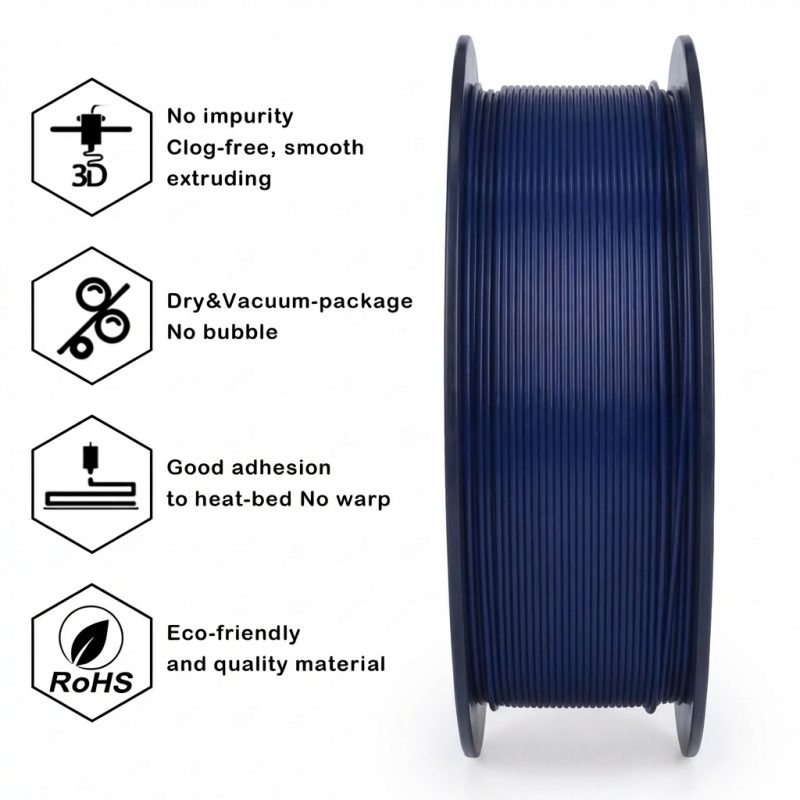
✅ RoHS compliant | 🏭 ISO 9001 | ♻️ PA6 recyclable | 📦 Vacuum sealed with desiccant
Shipping
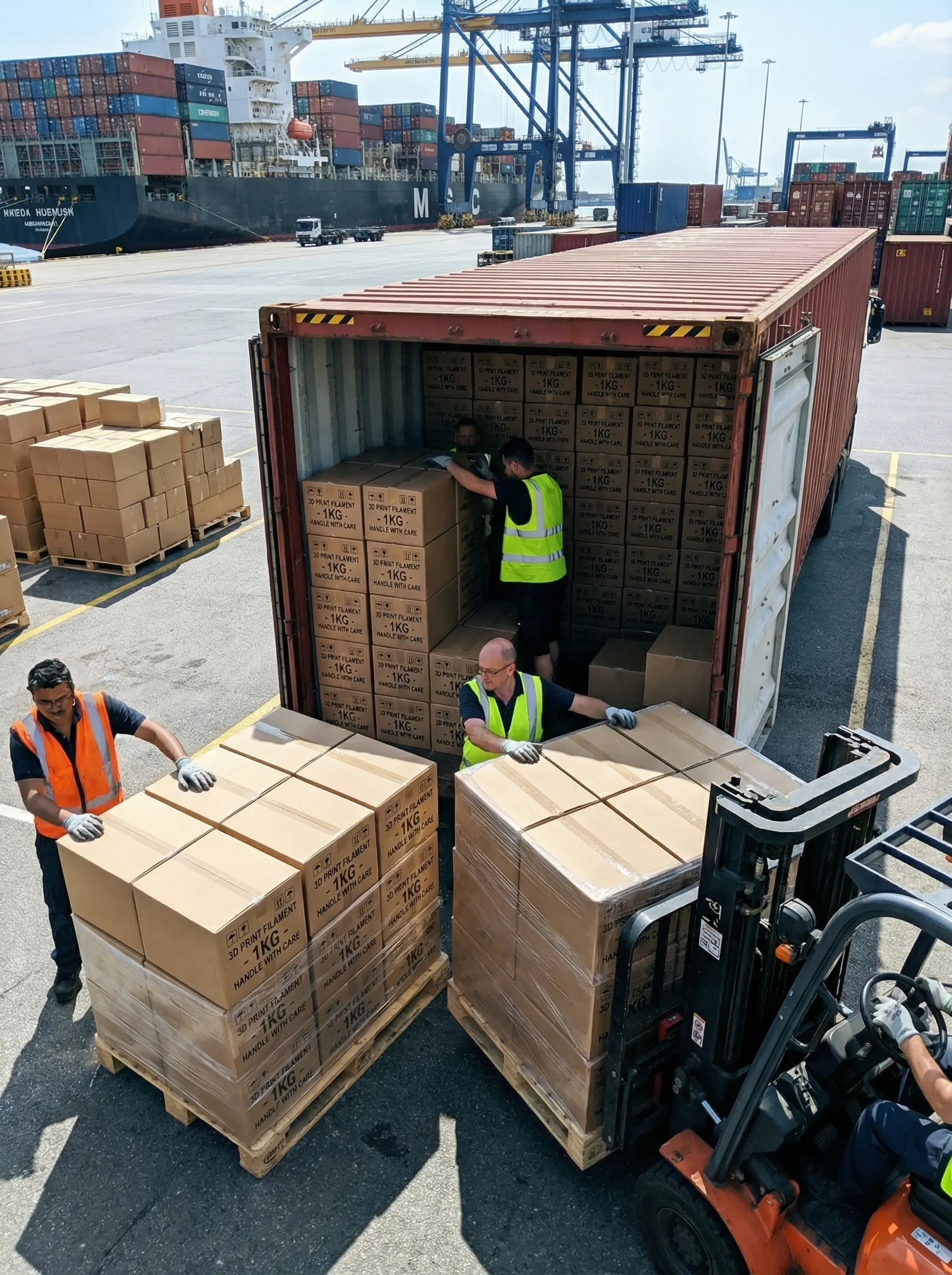
EU: 5-10 days (Express 3-5) | US: 7-12 days (Express 4-6) | UK: 7-12 days (Express 4-6) | Canada: 8-14 days (Express 5-7). DDP/DAP available.
Bulk & OEM/ODM
Flexible MOQ, free samples, 100kg+/500kg+/1000kg+ volume pricing. Custom PA6-CF formulations: adjustable CF content (10-30%), custom fiber types (carbon/glass/hybrid), custom base resins (PA6/PA12/PA66). Custom spool sizes. Private label. Learn more.
Storage
15-25°C, below 20% RH (critical – PA6 is hygroscopic), 6 months sealed (shorter than PLA/PETG due to moisture sensitivity), dry 80°C 8-12h before EVERY print session. Store opened spools in sealed dry box with desiccant.
Printer Compatibility
Requirements: All-metal hotend rated 300°C+. Hardened steel nozzle. Heated bed 100°C+. Enclosed printer strongly recommended. Not suitable for basic/entry-level printers.
| Bambu Lab X1C ✓ with hardened nozzle | Prusa MK4 ✓ with enclosure | Voron 2.4 ✓ Ideal | QIDI X-Max 3 ✓ Enclosed | Raise3D ✓ Industrial | Creality K1 ⚠️ Check hotend temp |
FAQ
Ready for Industrial-Grade 3D Printing?
Contact SigmaFilament today for bulk pricing, free samples, or to discuss custom PA-CF formulations for your engineering requirements.
📧 Email us for a quick quote | 🌍 Worldwide shipping with DDP/DAP | 🎁 Free samples for qualified customers
| Color | Black |
|---|---|
| Filament Diameter | 1.75mm ,2.85mm (3.00mm) |
| Spool Weight | 1kg ,3kg ,5kg ,Sample (200g) |